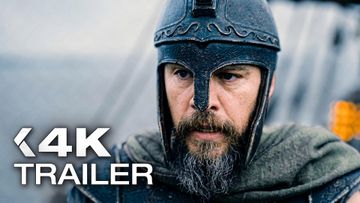
A True Epic! Our Meta Movie Review of Christopher Nolan's The Odyssey
We tell you whether Nolan's mythic action epic delivers – and break down what other critics have to say
At last, the wait is over: Christopher Nolan's new movie is hitting theaters! With his film adaptation of Homer's "Odyssey," the master director has taken on a truly ambitious project. Has Nolan created yet another masterpiece with his action epic? Find out what we and other critics think of the film in KinoCheck's META review!
Here's what it's about
Following the end of the Trojan War, Odysseus (Matt Damon) and his men set sail for their long-awaited journey home to Ithaca. But what should have been a straightforward voyage turns into an arduous odyssey, far longer and more perilous than anyone could have imagined. Odysseus and his crew face a number of mythical challenges along the way, encountering a Cyclops, the sorceress Circe (Samantha Morton), and the nymph Calypso (Charlize Theron).
Meanwhile, back home, stories circulate about Odysseus' triumph in Troy – but his fate remains unknown. His wife Penelope (Anne Hathaway) and son Telemachus (Tom Holland) have been waiting in vain for many years for his return, which hardly anyone in Ithaca expects anymore. As a result, numerous suitors now compete for Penelope's hand, including the ambitious Antinous (Robert Pattinson). Determined to stop them, Telemachus eventually sets out on a journey of his own to find his father.
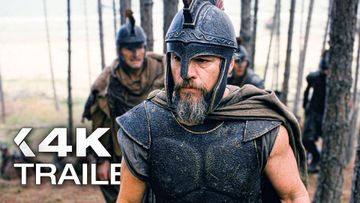
How does Nolan tell the story of The Odyssey?
Unsurprisingly, Nolan does not tell "The Odyssey" in a straightforward, linear fashion. Instead, he begins his narrative about eight years after the Trojan War. Through flashbacks and recollections of characters like Odysseus, however, we repeatedly travel back in time – including to the end of the Trojan War and to the various stages of his journey home.
This nonlinear structure (as is so often the case with Nolan) is not merely a gimmick, but serves a purpose. We look back into the past alongside Odysseus, connecting the different time periods, and are only told explicitly at a later point what the film is primarily concerned with. But there's no need to reveal more about the structure of "The Odyssey" at this point. Despite its intricate construction, the film never becomes overly convoluted or difficult to follow.
Thematically, Nolan once again explores some of his signature core themes. Amy Nicholson (L.A. Times) even describes the film as a "Trojan horse of his thematic obsessions." As is so often the case with Nolan, themes such as time, memory, and storytelling play an important role. Once again, Nolan tells the story of an extraordinarily difficult journey home.
A Visually Stunning Epic
There is one point on which nearly all critics agree: "The Odyssey" is visually incredibly impressive – whether in action sequences, landscape shots, or in the depiction of mythical creatures. Speaking for the many rave reviews of the audiovisual experience, David Fear (Rolling Stone) describes it as follows:
"Nolan is mounting an all-out campaign on eyes, ears, and nervous systems, and he and Oscar-winning cinematographer Hoyte van Hoytema utilize the sheer size of IMAX imagery (it's the first narrative feature film to be entirely shot in the format) to the utmost. Everything from a claustrophobic view from inside a crowded gift horse to a ship being battered by Poseidon's wrath is blown up to maximum proportions."
With "The Odysee", Nolan creates an opulent epic in which several shots and images (including the Trojan Horse on the beach!) are particularly memorable. Bringing such a monumental story to the screen in this form truly deserves great respect, as Empire critic John Nugent also emphasizes.
"The scale and scope here is, frankly, jaw-detaching. It is filmmaking at a magnitude few modern directors could ever realistically imagine, demand, or execute."
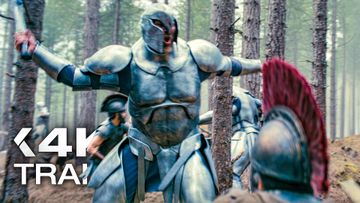
The Audiovisual Experience
Ludwig Göransson's score deserves special mention. Once again, the Göransson proves himself a worthy successor to Hans Zimmer, who famously served as Nolan's longtime collaborator before Göransson took over. As is typical of the Swedish composer, he doesn't necessarily take the conventional route, but instead blends classical and modern elements in his compositions. Overall, his score is somewhat more restrained than in "Tenet" or "Oppenheimer." Yet Göransson strikes exactly the right note, whether during the film's quieter character moments or its grand, larger-than-life set pieces.
Some of the film's finest sequences emerge when Nolan's direction and Göransson's score work in perfect harmony. This is especially true of the thrilling action scenes, with the flashback sequences set during the Trojan War standing out as particular highlights. Staged with Nolan's trademark precision and intensity, these moments rank among the film's greatest achievements. Ultimately, the audiovisual experience – and several of the film's spectacular set pieces – are nothing short of extraordinary.
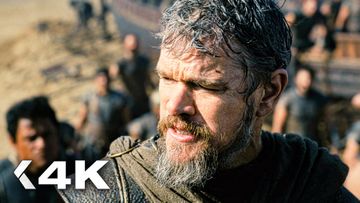
An A-List Ensemble
For many critics, the cast is also one of the film's strengths. It brings together a veritable "who's who" of Hollywood. In addition to the lead actors mentioned above, the cast includes Zendaya as the goddess Athena, Jon Bernthal as King Menelaus, Lupita Nyong'o in a dual role as Helen of Troy and her sister Clytemnestra, and Elliot Page as the soldier Sinon.
Many critics have singled out Anne Hathaway, Robert Pattinson, and John Leguizamo, who plays Odysseus's loyal subordinate Eumaeus. But above all, Matt Damon's performance is repeatedly praised. The most enthusiastic critics even consider it one of the best performances of Damon's career, including IndieWire critic David Ehrlich:
"By turns loving, arrogant, sensitive, guilt-stricken, blameless, pig-headed (almost literally), brilliant, and foolish, Damon's Odysseus is a monument to his multifacetedness as an actor."
An Odyssey with Strengths and Weaknesses
However, some reviews repeatedly point out similar negative aspects. For some, the somewhat bumpy start is too uneven. But the middle section also draws criticism. In his otherwise glowing review of "The Odyssey" on The Big Picture podcast, Sean Fennessey remarks that the different stages of Odysseus' journey can occasionally feel like a checklist being worked through.
We largely agree. Some episodes of Odysseus' journey are more compelling than others. Nolan doesn't always find a fresh or particularly engaging perspective on every stop along the way; at times, it feels too much like a simple retelling of the events in Homer's original.
But after a middle section with some minor weaknesses, the film really picks up steam in its third act. This is where the nonlinear narrative structure shines, and Nolan is able to create a cohesive overall picture by interweaving the past and the present. The ending practically invites you to watch the film again. It allows us to see some of what came before in a different light.
While this concept may seem somewhat unorthodox, it actually enhances the film. The interweaving of different time periods and narrative threads is a well-known strength of Nolan's. Most recently, he masterfully executed this approach in "Oppenheimer" – and it works similarly here in "The Odyssey."
A Familiar Point of Criticism
Opinions vary when it comes to the emotional component. Some critics see "The Odyssey" as one of Nolan's most emotional films, but others criticize a certain emotional distance from the characters. It's an all-too-familiar criticism that has been leveled at Nolan in several of his films.
We agree: the emotional spark doesn't quite ignite. In "Interstellar," for example, Nolan succeeded better in this regard. Variety critic Guy Lodge writes that "The Odyssey" is "more sensually than emotionally felt." In other words, the film makes its impact primarily through its imagery, atmosphere, or the audiovisual experience. "The Odyssey" therefore doesn't quite reach the top level in all its facets that Nolan has achieved in some of his other films. But the bar is simply set very high in his filmography.
Conclusion
Our verdict: "The Odyssey" is a thrilling and breathtaking cinematic experience, featuring a compelling narrative structure, fascinating themes, and a few weaknesses along the way.
We're already looking forward to watching the film a second time! But see for yourselves: "The Odyssey" is now playing in theaters. We hope you enjoy it!
By the way: To celebrate the theatrical release of "The Odyssey," we asked our community what their favorite Christopher Nolan movie is. Here's the ranking from the KinoCheck community.